
Executive Summary
This report explains the design of a standard documentation system for managing Ubuntu Server 24.04 LTS. The goal was to build a clear and repeatable way to manage how a server is set up and kept secure. The framework includes standard procedures, maintenance plans, security guidelines, and operational checklists. These tools help prevent mistakes, maintain system reliability, and facilitate error checking.
1.0 Project Description
1.1 Objective
Designed and implemented a standardized documentation system for Ubuntu Server 24.04 LTS administration.
1.2 Technical Environment
Platform: Ubuntu Server 24.04 LTS.
Hypervisor: VirtualBox.
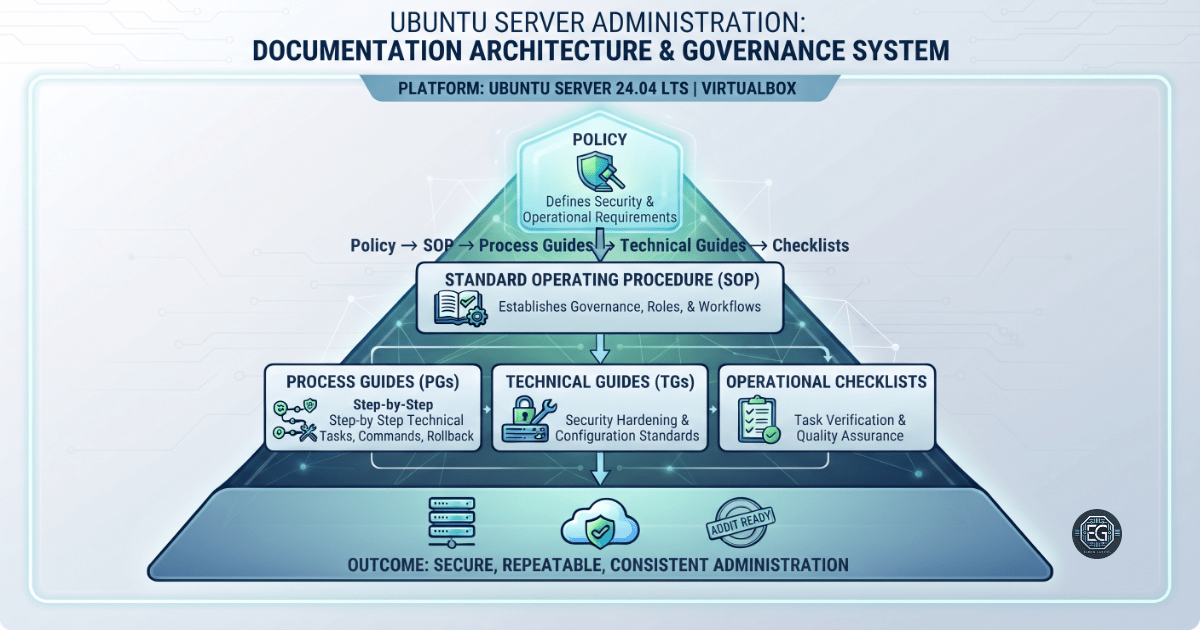
Documentation Architecture: Policy → SOP → Process Guides → Technical Guides → Operational Checklists.
1.3 Deliverables
| Deliverable | Description |
|---|---|
| Standard Operating Procedure | Defines governance, roles and responsibilities, operational procedures, maintenance plans, and checklists. |
| Process Guides | Provides simple, step-by-step instructions. |
| Technical Guides | Sets security rules and setup standards. |
| Operational Checklists | A list to verify and record that work is done correctly. |
2.0 Documentation Architecture
The system is built with a clear hierarchy. Each document has a specific purpose. By separating the rules, technical steps, and checks, everything is easier to manage and update.
Policy: Defines the security and operational requirements of the organization.
Standard Operating Procedure (SOP): Describes governance, who is responsible for what, and the standard workflows.
Process Guides (PGs): Provide detailed procedures, including commands, validation steps, and rollback steps if something goes wrong.
Technical Guides (TGs): Sets rules for security and best practices.
Operational Checklists: Used to verify that tasks are completed correctly.
3.0 Framework Components
| Component | Purpose |
|---|---|
| Governance | Lists who has authority and their duties. |
| Standard Operating Procedures | Defines the main work rules. |
| Operational Governance | Manages maintenance schedules. |
| Security Reviews | Checks that security rules stay in place. |
| Process Guides | Explains how to do technical tasks. |
| Technical Guides | Explains security settings. |
| Operational Checklists | Confirms tasks are finished. |
4.0 Framework Overview
This framework separates governance, technical procedures, and validation activities. This makes the documentation easier to update. It also makes it faster to train new staff, helps keep servers consistent, and ensures that administrators follow the same steps every time.
5.0 Project Outcome
The project created a fully documented system. This structure:
- Makes administration more consistent.
- Makes maintenance easier to predict.
- Helps new administrators learn faster.
- Provides a foundation for future documentation.
6.0 CONCLUSION
6.1 Key Takeaways
Governance: Standard procedures help protect the systems and reduce errors.
Repeatability: A layered structure ensures tasks are done the same way, no matter who does them.
Readiness: Checklists and backup plans help resolve issues and pass audits.
6.2 Security Implications
Risk: Undocumented Changes When administrators make changes without writing them down, the system becomes difficult to manage. This creates security gaps and leads to human error.
Recommendation: Organizations should adopt a “documentation-first” approach. In this model:
- Perform administrative tasks using the approved SOPs.
- Follow Process Guides for technical tasks.
- Verify the results using operational checklists.
This approach strengthens governance, improves consistency, reduces configuration drift, and supports the long-term maintainability of Ubuntu Server environments.