
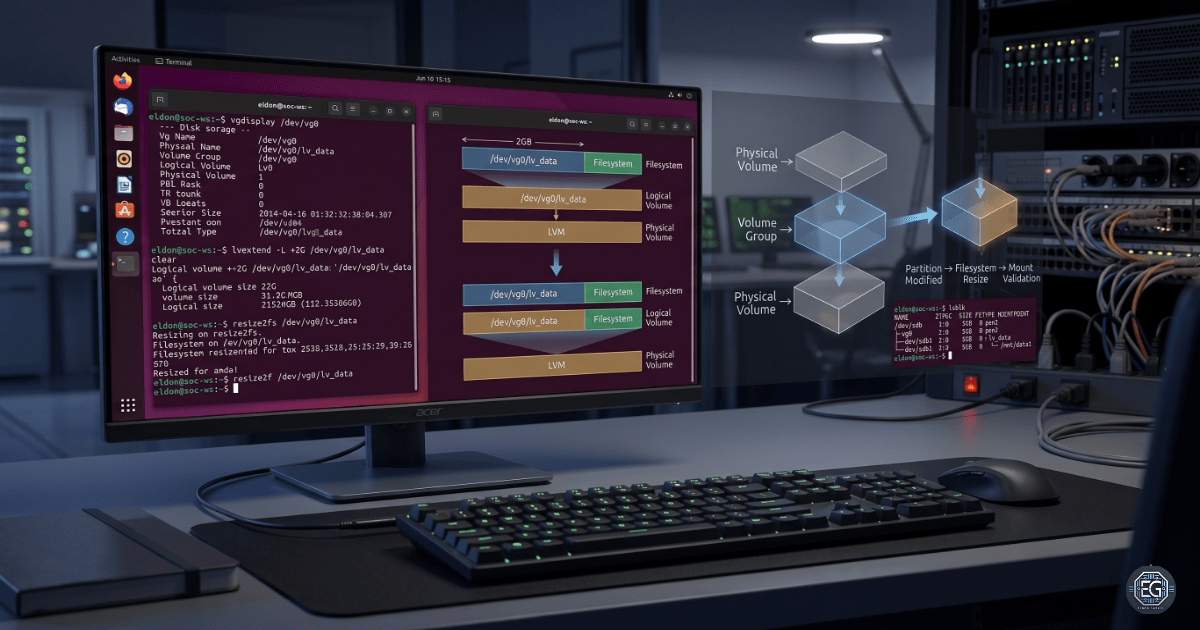
0.0 Executive Summary
This report documents the live expansion of an LVM logical volume and its associated filesystem on an Ubuntu system. The objective was to increase the available storage for a specific directory without service interruption.
The process utilized the Logical Volume Manager (LVM) abstraction layer to perform a multistep expansion by verifying the volume group capacity, extending the logical volume at the block level, and synchronizing the filesystem metadata.
The result is a validated, non-destructive workflow for scaling storage resources on production servers while maintaining system availability and preventing disk overloading.
1.0 LVM Partition Expansion
1.1 Project Description
The goal of this task was to develop proficiency in managing the Logical Volume Manager (LVM), specifically performing live volume expansions to handle increasing storage demands.
This implementation demonstrates:
- LVM Abstraction Management: Separating physical storage from the filesystem layer.
- Live Scaling: Increasing storage capacity without unmounting or rebooting.
- Three-Layer Validation: Coordinating changes across filesystem, block, and metadata layers.
- Resource Analysis: Using volume group metadata to determine available expansion capacity.
1.2 Technical Execution and Troubleshooting
Issue
The /home directory reached capacity, requiring an immediate 2GB increase in storage without system downtime.
1.2.1 Metadata and Capacity Audit
- Verification of Free Space:
vgdisplayused to confirm sufficient “Free PE” (Physical Extents) within the volume group.
1.2.2 Logical Volume Extension
- Block Allocation:
sudo lvextend -L +2G /dev/ubuntu-vg/ubuntu-lvexecuted to extend storage at the LVM layer.
1.2.3 Filesystem Synchronization
- Metadata Update:
sudo resize2fs /dev/ubuntu-vg/ubuntu-lvused to expand the filesystem into the newly allocated space. This step is required to make the storage usable by the user.
Key Insight
LVM enables dynamic storage resizing; however, the process is incomplete until resize2fs synchronizes the filesystem with the logical volume.
Troubleshooting Highlights
- The “Invisible Capacity” Trap:
lvextenddoes not reflect indf -huntil the filesystem is resized. - Path Ambiguity: Using mount points instead of the device mapper path can cause command failures. The correct reference is
/dev/ubuntu-vg/ubuntu-lv.
1.3 Resolution and Validation
Validation (Three-Layer Protocol)
- Filesystem Layer:
df -h /homeconfirmed updated capacity was available to the OS. - Block Layer:
lsblkverified updated partition mapping. - Metadata Layer:
lvdisplayconfirmed logical volume expansion.
Tool Mapping
| Layer | Tool Used |
|---|---|
| Metadata/Pool | vgdisplay |
| Logical Volume | lvextend |
| Filesystem | resize2fs |
| Validation | df, lsblk |
2.0 CONCLUSION
2.1 Key Takeaways
- LVM separates physical storage from the filesystem, enabling live modification.
lvextendhandles block allocation, whereasresize2fsupdates filesystem usability.- Always verify the volume group capacity before expansion.
- Live expansion supports production environments by preventing the downtime.
2.2 Security Implications and Recommendations
Risk: Disk Exhaustion leading to Denial of Service (DoS)
Running out of disk space on critical partitions (e.g., /var/log and /home) can cause service failure or system instability.
Mitigation:
- Regularly monitor the volume group capacity.
- Alerts for low storage thresholds were configured.
Risk: Configuration Drift
Untracked storage changes may lead to inconsistencies between the system state and documentation.
Mitigation:
- Log all
lvextendoperations in the change management records. - Validate the storage state after each modification.
Best Practices
- Confirm LV path using
lvdisplaybefore executing the changes. - Avoid using mount points for LVM operations.
- Validation is performed after all storage modifications.
Framework Alignment
- NIST SP 800-53 (CP-9): System backup and storage availability.
- CIS Control 12: Infrastructure management and monitoring.
- ISO 27001 (A.12.1.3): Capacity and resource management.